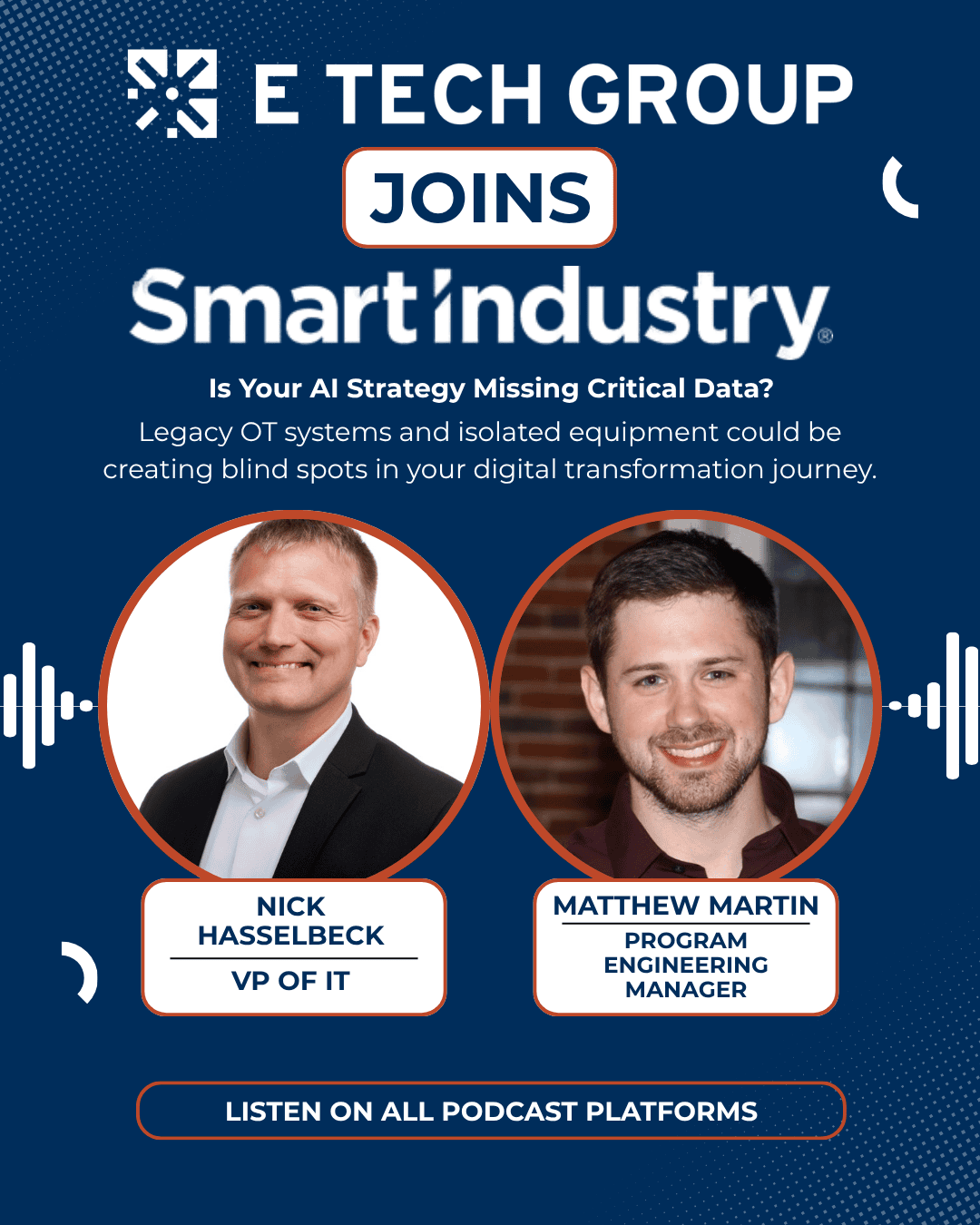
Digital transformation and AI initiatives are accelerating across manufacturing, but many organizations face a challenge they may not realize: outdated operational technology (OT) systems can create significant blind spots that limit the success of AI and data-driven initiatives. That was the focus of a recent episode of Smart Industry’s Great Question: A Manufacturing Podcast, featuring E Tech Group’s own Nick Hasselbeck, Vice President of IT, and Matt Martin, Principal Engineer.
Addressing the Hidden Challenges of AI Readiness
In the episode, Nick and Matt joined Smart Industry’s Scott Achelpohl to discuss how legacy OT systems and limited network visibility can quietly undermine digital transformation efforts. They explored a critical question many manufacturers are asking today:
Can your organization fully leverage AI if some of your most valuable operational data remains trapped within disconnected systems?
The discussion highlighted how many facilities operate with a mix of modern and legacy automation and control equipment, creating challenges when organizations attempt to integrate AI, industrial analytics platforms, MES/MOM systems, data lakes, and other advanced technologies.
This structural fragmentation can lead to data silos – where local equipment is isolated from the broader network, restricting access to vital operational data. Without trusted, contextualized real-time operational data from the shop floor, AI-driven analytics may generate skewed or inaccurate predictive models for energy consumption, production benchmarks, predictive maintenance, etc.
From “Islands of Automation” to Connected Operations
During the conversation, Nick and Matt shared practical approaches manufacturers can take to improve visibility and connectivity across their operations. Topics included:
- Understanding the risks and opportunities associated with connecting legacy OT systems to modern networks.
- Evaluating whether aging equipment should be upgraded, replaced, or enhanced with additional sensors and data collection capabilities. Operational risk must be balanced with capital expenditure – advanced ICS security teams can perform targeted system retrofits that extend the lifespan of heavy assets.
- Using technologies such as thermal monitoring, vibration sensing, and modern connectivity solutions to bring valuable operational data into today’s digital ecosystems. Facilities can harvest ambient machine data by deploying non-invasive smart sensors or wireless protocols, eliminating the need to alter verified PLC logic, risk warranty violations, or put critical machinery at risk.
- Building collaboration between IT, OT, and business stakeholders to support successful AI and digital transformation initiatives.
The episode also emphasizes that AI success begins with data accessibility. Before organizations can deploy advanced AI solutions, they must first understand what assets exist, where critical data resides, and how that information can be securely and effectively integrated into their broader technology strategy.
A major takeaway from the talk is that AI models are only as effective as the data they learn from. Manufacturers are keen to invest in enterprise AI software, but without proper integration, something as simple as a legacy sensor that incorrectly scales its analog signal can render machine learning technology useless, as it optimizes for false parameters. Any viable AI automation initiative requires intensive IT/OT risk assessment and remediation followed by a FEED study to ensure operations maximize the usability of their upgraded automation architecture. Successful AI initiatives depend on a foundation of clean, contextualized operational data, secure infrastructure, and effective integration between OT and enterprise systems.
E Tech Group’s Commitment to Smart Manufacturing
As a leader in industrial automation, controls, digital transformation, and IT/OT integration, E Tech Group helps manufacturers bridge the gap between operational technology and enterprise systems. We are proud to have our experts contribute to industry conversations that help organizations navigate the complexities of modernization and prepare for the future of manufacturing.
We appreciate Smart Industry for the opportunity to share our team’s expertise and insights with the manufacturing community.
Listen to the Episode
We invite you to hear the conversation and learn more about the insights our team shared.