
Why OT Infrastructure Has Become a Business Imperative
Food and beverage manufacturers face constant pressure to increase throughput, maintain product quality, support food safety programs, ensure traceability, meet regulatory requirements, and reduce downtime. Successful operations depend on reliable OT infrastructure that supports both production and compliance objectives.
At the same time, many facilities are pursuing initiatives involving Manufacturing Intelligence, AI, advanced analytics, MES platforms, remote operations, and digital transformation. These technologies promise significant value, but they also place new demands on operational technology (OT) infrastructure that was often deployed years or even decades ago.
Many production environments contain a mix of legacy and modern systems, undocumented network changes, aging hardware, and cybersecurity gaps that have accumulated over time. While these issues may not impact daily operations immediately, they can create hidden risks that affect reliability, resilience, and future modernization efforts.
Before manufacturers can modernize with confidence, they need a clear understanding of the assets, networks, and dependencies that support their operations.
Five Common OT Infrastructure and Security Vulnerabilities Found in Food & Beverage Facilities
1. Aging Infrastructure Limits Reliability and Growth
Many manufacturers continue to rely on automation platforms, servers, workstations, controllers, and network equipment that are reaching the end of their supported lifecycle.
As infrastructure ages:
- Hardware failures become more common
- Vendor support may become limited or unavailable
- Spare parts become increasingly difficult to source
- New software and security tools may not be compatible
- Maintenance costs often increase
Aging systems present more than a reliability challenge. They can also create roadblocks when organizations attempt to implement Manufacturing Intelligence platforms, cloud integrations, cybersecurity improvements, or AI-enabled applications.
Without a plan to address infrastructure obsolescence, modernization efforts often stall before they begin.
2. Hidden Network Assets Create Operational Blind Spots
One of the most common findings during an IT/OT assessment is the presence of unmanaged or undocumented devices that operations teams may not realize are connected to the network.
These assets often include:
- Industrial network switches
- HMIs
- Industrial PCs
- Legacy servers
- Remote access devices
- Third-party OEM equipment
- Wireless infrastructure
When assets are not fully documented, troubleshooting becomes more difficult, maintenance takes longer, and risk assessments become less reliable.
A complete asset inventory is often the first step toward improving both operational reliability and cybersecurity.
3. Flat Networks Increase Operational Risk
Many food and beverage facilities still operate with limited segmentation between production systems, business networks, and supporting infrastructure.
In these environments:
- Operational issues can affect multiple production areas
- Troubleshooting efforts become more complex
- Maintenance activities carry greater risk
- Recovery times may increase during incidents
- Cybersecurity events can have broader operational impact
Proper network segmentation helps isolate systems, reduce exposure, and improve resiliency across the manufacturing environment.
It also creates a stronger foundation for future cybersecurity initiatives and compliance requirements.
4. Weak Cybersecurity Controls Leave Critical Systems Exposed
As IT and OT environments become increasingly interconnected, production systems face growing exposure to cyber threats.
Common gaps identified in manufacturing environments include:
- Shared user accounts
- Inconsistent password policies
- Outdated operating systems
- Unsupported hardware
- Limited network monitoring
- Incomplete asset visibility
- Lack of documented access controls
Cybersecurity is often viewed as an IT responsibility, but many cyber-related incidents can result in production interruptions, traceability challenges, quality concerns, delayed shipments, and increased recovery costs.
Reducing these risks starts with understanding the current state of the OT environment.
5. Unsecured Remote Access Introduces Additional Vulnerabilities
Remote support has become an essential part of modern manufacturing operations. Internal teams, OEMs, integrators, and service providers frequently require remote access to troubleshoot and maintain systems.
However, improperly managed remote access can create one of the largest attack surfaces within an OT environment.
Leading practices include:
- Multi-factor authentication
- Role-based access controls
- Secure remote access platforms
- Session monitoring and logging
- Documented approval procedures
- Periodic access reviews
When remote connectivity is properly managed, manufacturers can balance operational support needs with risk reduction and security objectives.
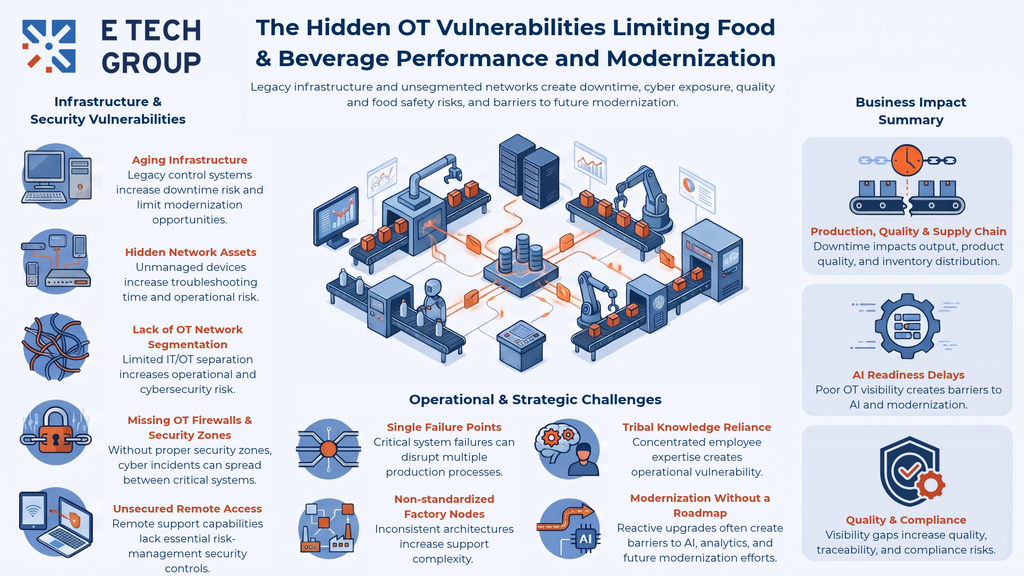
The Operational Challenges Beneath the Surface
Technical vulnerabilities rarely remain technical problems.
Over time, they create broader operational challenges that affect productivity, maintenance, and business performance.
Single Points of Failure
Many facilities unknowingly depend on a single server, switch, workstation, controller, or network path to support critical operations.
When these assets fail, multiple production areas may be impacted simultaneously, resulting in unexpected downtime and costly recovery efforts.
Inconsistent Standards Across Sites
As organizations grow through acquisitions, facility expansions, or independent plant initiatives, OT environments frequently evolve in different directions.
The result can be inconsistent technologies, documentation standards, network architectures, and support practices across facilities.
These inconsistencies increase maintenance complexity and make enterprise-wide modernization efforts significantly more difficult.
Tribal Knowledge Dependencies
Many manufacturing facilities rely heavily on a small number of experienced employees who understand how systems were originally designed and modified.
When critical knowledge exists only in the minds of a few individuals, organizations assume significant operational risk.
Retirements, personnel changes, and workforce transitions can leave teams struggling to support essential systems.
Short-Term Technology Decisions
Short-term fixes often address urgent problems but may not support long-term business objectives.
Over time, these decisions can create additional technical debt and make future modernization efforts more challenging.
Without a documented roadmap, organizations may invest in technology that solves today’s issue while creating tomorrow’s limitation.
Why OT Infrastructure Matters for AI and Manufacturing Intelligence
Many food and beverage manufacturers are exploring ways to leverage AI, predictive analytics, Manufacturing Intelligence platforms, and data-driven decision-making.
However, these initiatives depend on accurate, accessible operational data.
Whether manufacturers are pursuing predictive maintenance, production optimization, quality analytics, energy management, or AI-enabled decision support tools, success depends on reliable operational data. Without a clear understanding of OT assets, network architecture, and system dependencies, organizations often struggle to collect, contextualize, and trust the information needed to support these initiatives.
The same OT visibility required for AI initiatives also supports product quality analytics, traceability reporting, and compliance monitoring. For food and beverage manufacturers, OT visibility is not just a technology requirement. It is a foundation for operational performance, quality, and regulatory readiness.
Organizations often discover that they cannot effectively deploy advanced analytics because:
- Critical assets are undocumented
- Network architecture is poorly understood
- Connectivity gaps exist between systems
- Legacy infrastructure limits data accessibility
- Asset inventories are incomplete
Before manufacturers can fully capitalize on AI and Manufacturing Intelligence initiatives, they must understand the infrastructure, systems, and data that support operational decision-making.
An Assessment Should Deliver More Than Findings
Many manufacturers already recognize that they have aging infrastructure, cybersecurity concerns, undocumented assets, or modernization challenges. The bigger question is where to begin.
An effective IT/OT assessment should provide:
- Complete asset and network visibility
- Minimal disruption to production
- Prioritized findings based on operational impact
- Quick-win improvements
- Actionable recommendations
- A roadmap aligned with reliability, cybersecurity, and modernization goals
Manufacturers should also look for partners that understand controls systems, industrial networks, cybersecurity, and production operations together.
As the first CSIA Enterprise Certified system integrator, E Tech Group applies standardized assessment methodologies, documentation practices, and reporting processes across locations. This helps manufacturers gain consistent visibility, compare facilities using a common framework, and prioritize reliability, cybersecurity, and modernization improvements across multiple sites.
From Assessment to Action
A comprehensive IT/OT assessment helps manufacturers:
- Identify and document OT assets and networks
- Uncover cybersecurity and reliability risks
- Highlight obsolescence and single points of failure
- Prioritize modernization investments
- Support Manufacturing Intelligence and AI readiness
- Improve visibility for quality, traceability, and compliance initiatives
Rather than reacting to failures one at a time, manufacturers can make informed decisions based on operational impact and long-term business goals.
Before launching your next modernization initiative, ask a simple question:
Do we have a complete understanding of the systems that keep our operations running?
If the answer is no, an IT/OT Assessment may be the best place to start.
Take the First Step Toward OT Visibility
Whether your goals involve reducing downtime, improving cybersecurity, supporting Manufacturing Intelligence, or preparing for future AI initiatives, understanding your OT environment is the first step. E Tech Group’s IT/OT Assessments help manufacturers gain complete OT visibility, minimize disruption during discovery activities, and establish a clear roadmap for reliability, security, and modernization.
Learn how an E Tech Group IT/OT Assessment can provide complete OT visibility, identify operational vulnerabilities, and create a prioritized roadmap for reliability, cybersecurity, and modernization.
Speak with an Expert
Reach out to us here and someone will respond within 24 hours.
"*" indicates required fields