Skip to content

News & Knowledge

We’re your source for automation news. Keep up with the latest industry updates and E Tech employee spotlights, as well as tips and guidance from our manufacturing experts.  

A Life Sciences East Project is Coming to a SMASHING End!

One of E Tech Group’s Life Sciences East customers is the Johns Hopkins University Applied Physics Lab. The lab supplies space craft programs to NASA for scientific research.  Life Sciences East supports one of its test facilities, maintaining the industrial control systems of the Thermal Vacuum chambers. One of the missions Johns Hopkins University tested in the facility LSE supports is getting ready to come to a SMASHING conclusion later this month. JHU tested the DART spacecraft in its lab.  The DART mission is NASA’s demonstration of kinetic impactor technology, impacting an asteroid to adjust its speed and path. The Dart spacecraft is scheduled to crash into the asteroid on September 26, 2022.   Project Overview The LSE Industrial Controls project showcases E Tech Group’s expertise in industrial automation and control system integration. The project involved implementing complex control strategies to enhance operational efficiency and system reliability. Key Achievements Outcomes of the project included: Client and Industry Impact This project demonstrates E Tech Group’s ability to deliver high-quality automation solutions that optimize performance and support long-term business objectives for industrial clients. Several people from LSE have worked on projects supporting JHU during the 6 years they have been a customer to maintain and upgrade the systems at JHU. To learn more about DART and its program and mission, click here.

Read More

Case study: Redesign the process, then the control system

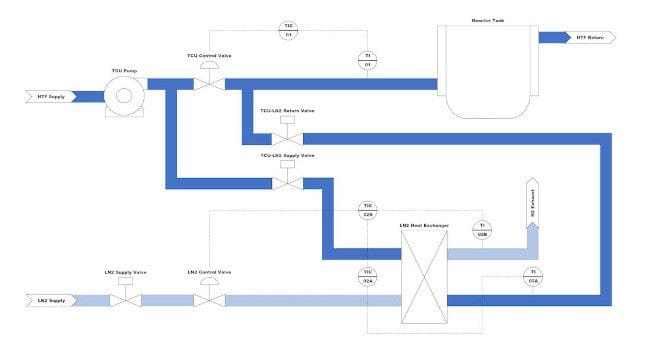
Author: Kevin Tom, E Tech Group lead automation engineer Pharmaceutical control system integration: Fixing a blind spot in the process design helped user requirements for a heat exchanger control system. A control system may not be able to fix a faulty process. Learning Objectives A system integrator was tasked with fixing a control system flaw for a pilot plant at a large pharmaceutical company. The integrator had to make several changes to the temperature control unit (TCU) to compensate for different variables with the liquid nitrogen flow. Thorough initial design and investigation helps prevent a scramble at the end of a project end to patch design holes. System Integration Insights System integrators are often the last people involved in an automation project, which gives them a unique perspective on operations. That perspective is a double-edged sword, though, and can be problematic if there are design flaws in the system. In this case study, the system integrator had to make several changes to the temperature control unit (TCU) to compensate for the liquid nitrogen flow, which resulted in a few challenges that had to be addressed. The adage of automation always coming last may well be true, but the system integrator can avoid some pitfalls if the initial design and investigation is thorough. A workable process design is the foundation for successful control system design. That can conflict with the timing of the old system integrator adage about new plant construction: “Automation always comes last.” It’s only after everything else is put in place that the system integrator can step in to install and test the control system, so they’re often the last member of the construction team. However, what happens when the system integrator encounters a conflict between the process design left to them and the practical operation of the … Continued

Read More

E Tech Group Automation Engineer Shares Expertise on Control Engineering Magazine Webcast

E Tech Group Lead Automation Engineer, Kevin Tom, shared his knowledge and expertise on Best Practices for Effective Automation Applications for Control Engineering Magazine‘s webcast on August 16th, 2022, where he discussed the nuances of control system applications. Highlights from the Control Engineering Magazine Webcast During the webcast, Kevin discussed several key topics: When Should a Process be Automated? Kevin explains the criteria that a company should consider when weighing whether or not to apply automation to a process: In considering automation, goals and constraints must also be hashed out: These questions are all addressed early on in a project’s inception, as stakeholders hold the keys to the budget needed for an automation project. However, control system engineers should also be consulted early on to give insight into the specifics of these questions, like cost, ROI, and improvement caps. The Importance of Knowledge Sharing in Automation Automation is a fast-evolving field, and staying current with best practices, emerging technologies, and industry standards is essential. By participating in webcasts, podcasts, and public forums, engineers can: Applying Automation is as Much Planning as Execution Kevin Tom’s cohost noted that, for many manufacturers, delaying automation is no longer viable given labor constraints and growth targets. It may sound histrionic, but the labor shortage is a real and pervasive issue, especially when manufacturers are trying to scale. Increased production goals mean hiring more people. But there aren’t enough people to be found, and/or high turnover, and/or lack of qualified professionals, which all present labor bottlenecks.  Automation is the best (and only) solution to avoiding the obstacles associated with labor shortages. However, it isn’t as simple as design-build-implement. For the transition to automation to run smoothly, the system first needs to be analyzed and verified virtually. This is another reason control system integrators should be involved in … Continued

Read More