
Skip to content

News & Knowledge

We’re your source for automation news. Keep up with the latest industry updates and E Tech employee spotlights, as well as tips and guidance from our manufacturing experts.  

What’s the Process of an IT/OT Risk Assessment like for a Facility Team?

When you’re working in a facility that has equipment reaching end of life or components that are on the verge of obsolescence, it would be nice to simply wave a wand and everything be instantly updated. Unfortunately, because multiple installations and upgrades have been done over a period of decades, this process tends to be a bit more involved. To better understand what’s wrong and what it will take to provide a fix, it really is imperative that the client is as involved in this process as are our engineers. When it’s Time to Consider a Control Systems Upgrade: IT/OT Risk Assessment Because of the sheer number of issues and temporary band-aids placed on them, our clients often don’t know where to start. Compounded fixes over time make it difficult to identify the main issue or issues. That’s where we come in and can help add some rigor to this process. If we can have an open line of communication with the client’s decision makers and maintenance team, we can help them better understand what we’re assessing and what it will take to correct it. The goal is to take a large amount of material and truncate it into digestible pieces that will allow all parties to evaluate potential solutions.  What the IT/OT Risk Assessment Process Actually Looks Like Custom Automation Solutions Don’t Have to Start from Scratch In many cases, maintenance technicians or employees may just think we’re there to redo the building. They see an engineer walking the floor and may assume they’re only there to complete a particular task, when in actuality, we’re there to perform an in-depth assessment and present options to give them control over what optimizations are implemented. Building automation and control systems integration is a specialized field; the client may not always be aware of the extent of what … Continued

Read More

Case study: Redesign the process, then the control system

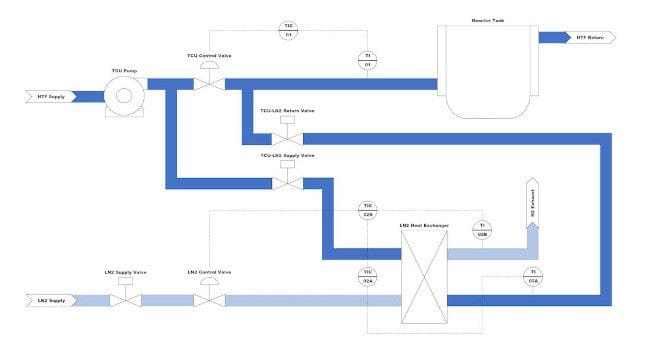
Author: Kevin Tom, E Tech Group lead automation engineer Pharmaceutical control system integration: Fixing a blind spot in the process design helped user requirements for a heat exchanger control system. A control system may not be able to fix a faulty process. Learning Objectives A system integrator was tasked with fixing a control system flaw for a pilot plant at a large pharmaceutical company. The integrator had to make several changes to the temperature control unit (TCU) to compensate for different variables with the liquid nitrogen flow. Thorough initial design and investigation helps prevent a scramble at the end of a project end to patch design holes. System Integration Insights System integrators are often the last people involved in an automation project, which gives them a unique perspective on operations. That perspective is a double-edged sword, though, and can be problematic if there are design flaws in the system. In this case study, the system integrator had to make several changes to the temperature control unit (TCU) to compensate for the liquid nitrogen flow, which resulted in a few challenges that had to be addressed. The adage of automation always coming last may well be true, but the system integrator can avoid some pitfalls if the initial design and investigation is thorough. A workable process design is the foundation for successful control system design. That can conflict with the timing of the old system integrator adage about new plant construction: “Automation always comes last.” It’s only after everything else is put in place that the system integrator can step in to install and test the control system, so they’re often the last member of the construction team. However, what happens when the system integrator encounters a conflict between the process design left to them and the practical operation of the … Continued

Read More

E Tech Group Automation Engineer Shares Expertise on Control Engineering Magazine Webcast

E Tech Group Lead Automation Engineer, Kevin Tom, shared his knowledge and expertise on Best Practices for Effective Automation Applications for Control Engineering Magazine‘s webcast on August 16th, 2022, where he discussed the nuances of control system applications. Highlights from the Control Engineering Magazine Webcast During the webcast, Kevin discussed several key topics: When Should a Process be Automated? Kevin explains the criteria that a company should consider when weighing whether or not to apply automation to a process: In considering automation, goals and constraints must also be hashed out: These questions are all addressed early on in a project’s inception, as stakeholders hold the keys to the budget needed for an automation project. However, control system engineers should also be consulted early on to give insight into the specifics of these questions, like cost, ROI, and improvement caps. The Importance of Knowledge Sharing in Automation Automation is a fast-evolving field, and staying current with best practices, emerging technologies, and industry standards is essential. By participating in webcasts, podcasts, and public forums, engineers can: Applying Automation is as Much Planning as Execution Kevin Tom’s cohost noted that, for many manufacturers, delaying automation is no longer viable given labor constraints and growth targets. It may sound histrionic, but the labor shortage is a real and pervasive issue, especially when manufacturers are trying to scale. Increased production goals mean hiring more people. But there aren’t enough people to be found, and/or high turnover, and/or lack of qualified professionals, which all present labor bottlenecks.  Automation is the best (and only) solution to avoiding the obstacles associated with labor shortages. However, it isn’t as simple as design-build-implement. For the transition to automation to run smoothly, the system first needs to be analyzed and verified virtually. This is another reason control system integrators should be involved in … Continued

Read More

E Tech Group Director of Operations Featured on CSIA Podcast

A recent episode of CSIA’s podcast: Talking Industrial Automation, featured E Tech Group’s Director of Operations, Cassy Gardner. A decade of experience in engineering, sales and project management in the Life Sciences field has allowed Cassy to leverage her engineering and MBA degrees to help clients achieve their automation goals. On the podcast, Gardner discusses how she came into the field of automation, citing a professor who inspired her during her senior year and connected her to the automation professionals at Banks Integration, which later became a part of E Tech Group. Let’s look at some of the questions Cassy tackled in her podcast interview and her main talking points: Q: What kinds of trends and challenges are you seeing in industrial automation right now? Q: What is DEI and why is it important? Q: What do you mean by diversity? Engineering is a male-dominated field, but are there other things diversity applies to in the field of industrial automation? Q: What are some consequences of a lack of DEI? Q: How can promoting DEI help in engineering and automation specifically? Q: What does a focus on DEI look like? Q: What about the claims that there just isn’t diversity in the STEM pool no matter how hard you look? Q: For people who want to know more about DEI in automation engineering, where should they start? Q: What is E Tech Group doing to improve DEI? Listen to the full webcast on CSIA Exchange.

Read More