How to Perform a Risk Assessment
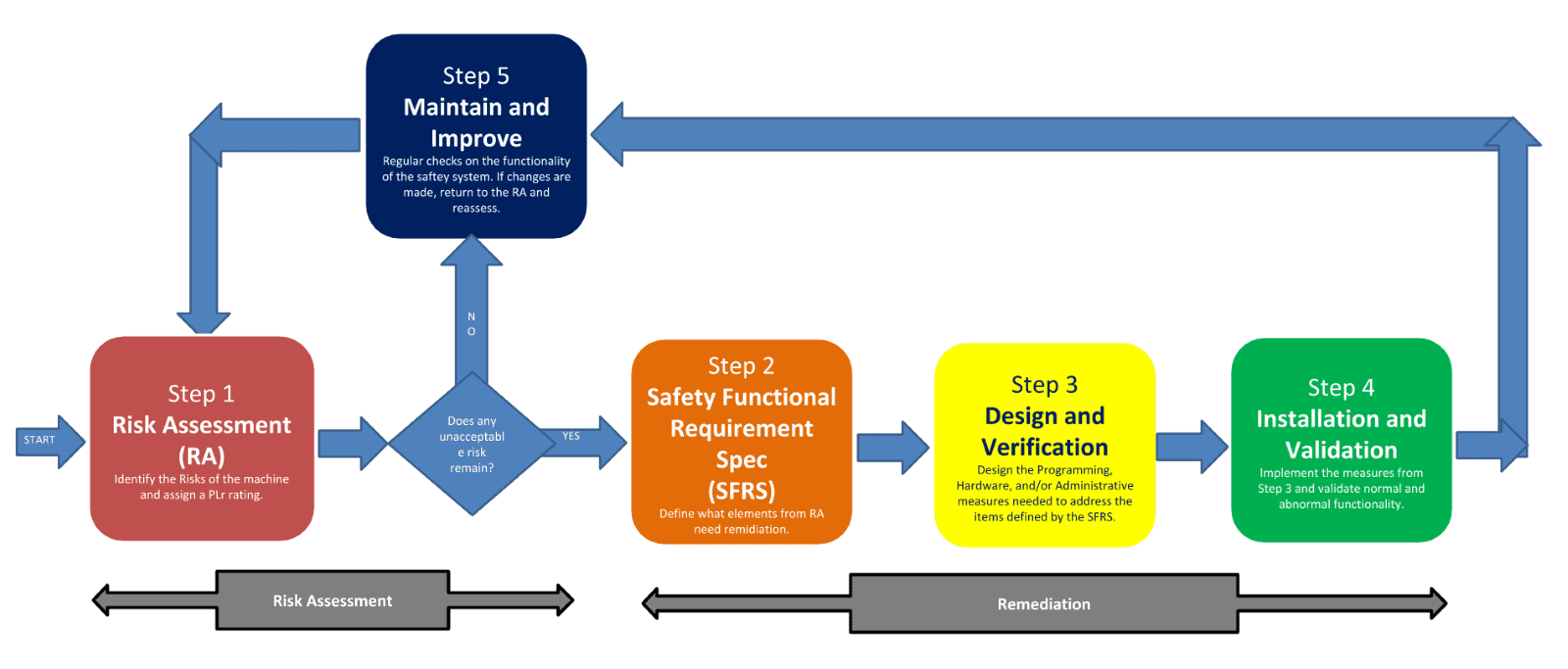
– By Tony Schalk, Functional Safety Engineer (TÜV Rheinland), Automation Systems Engineer, E Tech Group Sophisticated companies know that safety is a journey, not a destination. It is a part of their strategic, ongoing growth. As more and more companies look to implement safety programs, questions about budget, time, effort, and feasibility come into play. Larger companies may already employ a safety engineer or even a safety team, with well-established metrics and objectives each year. If you don’t fall into that category, don’t be discouraged. The most important thing you can do on any journey is to start. To begin your safety journey, you start with a risk assessment. In the United States, when an accident originates from machinery, the owner of the machine is responsible for the safety, not just the manufacturer of the machine. This means that if something happens, it’s technically your responsibility. Understanding this responsibility highlights the importance of a structured machinery safety program. The beauty of the risk assessment is that it is your education on what could happen with the machinery in your facility. What you choose to do with your newfound knowledge is up to you; however, in the immortal words of G.I. Joe, “Now you know, and knowing is half the battle.” There are a few caveats. Although companies could self-perform their risk assessments, it isn’t a job that just anyone in your plant can do. Risk assessments are often performed by professionals with training in machinery safety standards such as ISO 13849, IEC 62061, and related functional safety methodologies, as well as an understanding of ISO 13849 or IEC 62061 standards. Anyone could pick up the standard and follow the process, but it’s hard to implement a standard and its many details if you’re new to safety. This is where having … Continued